

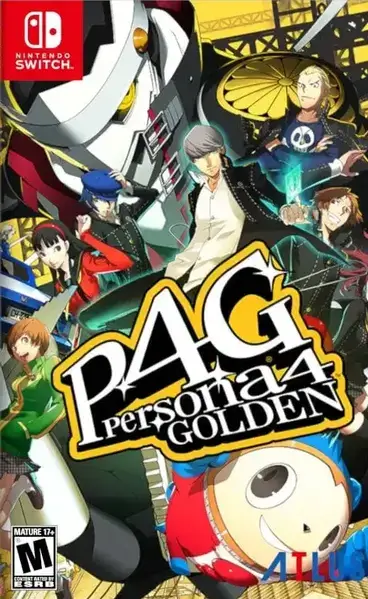
Download Persona 4 Golden ROM for Nintendo Switch.
To legally play your Nintendo Switch games on Ryujinx, you must extract your own game files (XCI/NSP) product keys and system firmware from a modded Nintendo Switch.
If you don't own the game yet, click the Buy Now button to get your copy. For those who already have the game, follow our official dumping guide to download and play it on Ryujinx.
Persona 4 Golden, was released for PlayStation Vita in 2012. It was later ported to Windows, Nintendo Switch, PlayStation 4, Xbox One, and Xbox Series X/S in the early 2020s, selling 2.5 million total copies worldwide. Persona 4 Golden is an enhanced re-release of Persona 4, which launched for the PlayStation Vita, it adds a variety of new content and convenience features to update the original game, extending its replay value. Golden was adapted into an anime, Persona 4 The Golden Animation. Persona 4 Golden adds two new Social Links to the game; Adachi and Marie, a mysterious girl who becomes an assistant in the Velvet Room and wishes to uncover her lost memories.
If the player advances Adachi’s Social Link to a certain level, they are given the choice to withhold his identity as the killer from the rest of the Investigation Team, thus leaving the mystery unsolved and resulting in the “accomplice” ending. On Yu’s final day in Inaba, he may choose to visit Adachi and destroy a crucial piece of evidence related to the case. Adachi then blackmails Yu, threatening to have him arrested for destroying evidence if he does not answer his calls. The game’s ending then plays out the same as the normal ending, but after the credits, Yu passes by Adachi at a level crossing. He clutches his phone in his hand as a smirk forms on Adachi’s face.
Persona 4 blends traditional RPG gameplay with simulation elements. The player controls the game’s protagonist, a teenage boy who is named by the player, who comes to the town of Inaba for a year. Gameplay is divided between the real world of Inaba, where the protagonist carries out his daily life, and the mysterious “TV World”, where various dungeons filled with monsters known as Shadows await. With the exception of scripted events, such as plot progression or special events, players can choose to spend their day how they like, be it participating in various real world activities, such as joining school clubs, taking part-time jobs, or reading books, or exploring the TV World’s dungeons to gain experience and items.
Days are broken up into various times of day, the most frequently recurring being “After School/Daytime” and “Evening”, with most activities causing time to move on. Certain activities are limited depending on the time of day, days of the week, and the weather, with most evening activities unavailable if the player visits the TV World that day. Furthermore, some activities and dialogue choices may be limited by the protagonist’s five attributes; Understanding, Diligence, Courage, Knowledge, and Expression, which can be increased by performing certain activities that build them.
Whilst the player is free to choose how to spend time, if someone who is trapped in the TV World is not rescued by the time fog appears in town, which takes place after several days of consecutive rain, that person will get killed by the shadows and the game will end, forcing the player to return to a week prior, or load a previous save file. As the game progresses, the protagonist forms friendships with other characters known as “Social Links”, which are each represented by one of the Major Arcana. As these bonds strengthen, the Social Links increase in Rank, which grant bonuses when creating new Personas in the Velvet Room.
Additionally, strengthening Social Links with the main party members grant them additional abilities, such as the ability to perform a follow-up attack or an additional ability for their Persona. The main focus of the game revolves around Personas, avatars projected from one’s inner self that resemble mythological figures and represent the façades worn by individuals to face life’s hardships. Each Persona possesses its own skills, as well as strengths and weaknesses to certain attributes. As Personas gain experience from battle and level up, that Persona can learn new skills, which include offensive, or support abilities used in battle, or passive skills that grant the character benefits.
Each Persona can carry up to eight skills at a time, with older skills needing to be forgotten in order to learn new ones. Whilst each of the main party members have their own unique Persona, which transforms into a stronger form after maxing out their Social Link, the protagonist has the “Wild Card” ability to wield multiple Personas, which he can switch between during battle to access different movesets. The player can earn new Personas from Shuffle Time, with the protagonist able to carry more Personas as he levels up. Outside of the dungeons, the player can visit the Velvet Room, where players can create new Personas, or summon previously acquired Personas for a fee.
New Personas are created by fusing two or more monsters to create a new one, which receives some of the skills passed down from its material monsters. The level of Personas that can be created are limited by the protagonist’s current level. If the player has built up a Social Link relating to a particular Arcana, then a Persona relating to that Arcana will receive a bonus upon creation. Persona 4 Golden added bike trips as a daytime activity, to be undertaken with each of the members of the party, individually. This grants a skill that party member would otherwise not be able to learn, or enables the relearning of previously discarded skills.